How Routines Help Build Responsible, Independent Children
You know the daily battles: bedtime, tidy-up time, getting dressed, putting the tablet away. And you may be thinking, why is this such a struggle every single night?
Often, what looks like disobedience is something much simpler: uncertainty.
Young children thrive on connection and predictability. When children know what comes next, and when that predictability is paired with a small, steady moment of connection, their brains can relax. Transitions become less of a struggle.
Routine is not about control. It is about clarity. And clarity helps build responsibility, independence, and autonomy.
Let’s look at why.
What Is a Routine, and Why Does It Matter?
A routine is a predictable sequence of events that happen in approximately the same order most days.
- Responsibility grows when children understand what is expected of them.
- Independence develops when they can complete tasks without constant prompts.
- Autonomy strengthens when they feel capable and trusted within clear limits.
And boundaries? Boundaries define what is acceptable and what is not. They communicate values and help children feel safe, respected, understood, and empowered. Routines put those boundaries into daily practice.
For example:
- Boundary: “We take care of our bodies.”
- Routine: Bath, pyjamas, brush teeth, story, bed, in that order.
Without routine, boundaries can feel random.
With routine, boundaries feel steady.
And steady situations feel safe.
The Brain Loves Predictability
In the early years, the brain develops at an extraordinary rate. Children’s neural connections are formed and strengthened through repetition and experience. When daily life is predictable, children experience less stress and stronger emotional regulation.
Research consistently shows that predictable environments support healthy brain development and emotional security in young children.1 When children can anticipate what comes next, their stress-response systems are less likely to become overactivated.2 Lower stress means the brain is more available for learning, memory, and self-control.
In simple terms, when children are not worried about what will happen next, they can focus on growing and learning.
Consistent routines have also been linked to improved self-regulation, better sleep, and stronger social-emotional development in children.3 These are foundations of responsibility and independence.
Predictability is a steady, calming force.
How Routines Build Responsibility
Responsibility is built through repetition, not lectures.
When children tidy toys before snack every day, they begin to internalise: This is what we do.
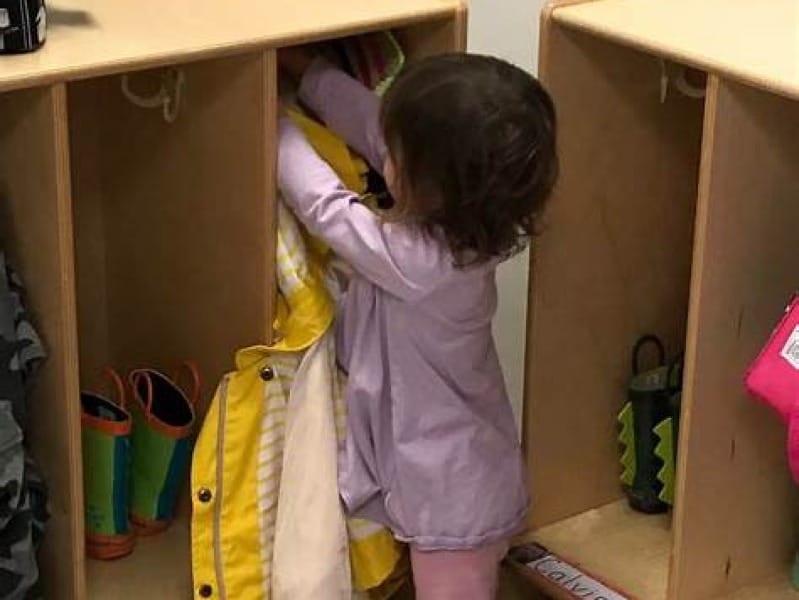
When shoes go in the same place each afternoon, they begin to understand cleanliness, order, and contribution.
When they help pack their bag each morning, they start participating in their own lives.
Routine removes the need for constant negotiation. Instead of Do I have to? The message becomes, This is part of our day.
Over time, something powerful happens: the parent steps back and can confidently ask:
- “What comes next?”
- “Show me how you do bedtime.”
- “What do we do after snack?”
The child remembers. The child acts. The child grows.
How Routines Support Independence and Autonomy
When children know the sequence of their day, they need fewer reminders. They anticipate transitions. They prepare themselves. This reduces stress and gives parents and caregivers more breathing room.
A preschooler who knows the bedtime steps can complete them with pride. A toddler who knows the cleanup routine after lunch may begin gathering toys or clearing the table before you ask.
Parents can build autonomy into routines and boundaries. This does not mean giving a child unlimited choice. It means offering simple, meaningful choices within clear limits.
For example:
- “It is pyjama time. Would you like the blue ones or the striped ones?”
- “After cleanup, we will have a snack. Would you like apples or yoghurt?”
The routine stays consistent. The child experiences control and independence within it. This balance builds confidence.
Autonomy, in everyday terms, is a growing sense of I can do this within safe and loving limits.
Why Parents Shy Away from Routines and Boundaries
Parents may hesitate, and for understandable reasons.
Fear of being too strict
Routines can sound rigid. We worry about becoming inflexible or controlling.
But routine is not the same as harshness. It works best when carried out calmly and consistently.
Guilt
Parents, especially busy or working parents, may hesitate to “add more rules.” They want their time together to feel relaxed.
Yet children often feel calmer, not constrained, by predictable patterns.
Exhaustion
It can feel easier in the moment to skip the routine than to hold the boundary.
Avoiding short-term discomfort often creates long-term struggle.
Avoiding meltdowns
Sometimes we bend boundaries to prevent tears.
Ironically, inconsistency increases anxiety, and anxiety increases meltdowns.
Consistency may bring protest at first, but it brings peace later.
Routine Without Rigidity
Healthy routines are predictable, but they do not need to be perfect.
Life happens, and flexibility is part of real family life. Travel, the arrival of a new sibling, visitors, and celebrations will cause disruptions.
The goal is rhythm, not rigidity.
A Gentle Reflection
If your family experiences daily friction, start small. Choose one moment of the day that feels chaotic—bedtime, mornings, or cleanup—and create a simple, repeatable sequence.
Keep it short. Keep it clear. Repeat it calmly.
Children do not need complicated systems. They need steady ones.
So, ask yourself:
- Where in our day do we struggle most?
- Is this a behaviour problem, or a predictability problem?
- What one small routine could reduce stress for everyone?
Remember: your child is not fighting you. Often, they react to uncertainty.
When we provide structure, we provide safety.
And from safety grows responsibility.
From responsibility grows independence.
From independence grows autonomy.
Structure today builds peace and strength tomorrow.
Footnotes
1. Center on the Developing Child at Harvard University. InBrief: The Science of Early Childhood Development. Harvard University, 2016. ↩
2. Shonkoff, J. P., & Garner, A. S. (2012). “The lifelong effects of early childhood adversity and toxic stress.” Pediatrics, 129(1), e232–e246. ↩
3. Spagnola, M., & Fiese, B. H. (2007). “Family routines and rituals: A context for development in the lives of young children.” Infants & Young Children, 20(4), 284–299. ↩