A is for Active Learning: Raising Curious, Confident, and Joyful Learners
“Mommy, why is the moon following us?”
“Daddy, what happens if I pour this water in here?”
“Grandma, why do ants walk in a line?”
If you live with a young child, you know curiosity does not arrive quietly. It comes through questions, climbing, pouring, pretending, pulling apart, wondering.
Welcome to A – Active Learning in the GREATEST Roadmap for Early Years Parents.
So far, we have explored Growth, Relationship, and Engagement. Now we begin Active Learning: helping children become curious, confident, and joyful explorers of the world.
What Does Active Learning Mean?
Active learning is not about flashcards, worksheets, or sitting still while adults pour information into a child. It is about children doing, touching, testing, asking questions, making choices, making mistakes, and trying again through real experience.
In active learning, a child participates with the whole body, mind, and heart. The child discovers that learning is something they help create.
Research strongly supports this approach. Lillard and colleagues found that rich, open-ended play is connected to growth in executive function, self-regulation, and problem-solving – skills that support later academic and social success.¹
Scenario: The Puddle Scientist
Three-year-old Maya is walking with her father after the rain. She spots a puddle and steps into it.
Splash!
Her father’s first thought is, “Oh no, her shoes!” But before he speaks, he notices Maya watching the water move around her feet.
She jumps again. “Look! It gets big!”
Her father kneels and says, “What do you think will happen if you jump softly?”
Maya tries a tiny jump. The splash is smaller. Then she tries a big jump. The splash is huge.
In that simple moment, Maya is learning about cause and effect, force, size, comparison, prediction, and language. Her curiosity has met a real experience. That is active learning.
Curiosity Is Not a Nuisance
Parents sometimes describe endless “whys” as exhausting. And honestly, they can be. Dinner needs cooking. Laundry is waiting. Someone lost a shoe again.
But curiosity is also a clear sign that a child is noticing, wondering, and making sense of the world. Engel’s research reminds us that curiosity can be nurtured when children ask questions, explore, and follow their interests.²
A child who asks, “Why do leaves fall?” is observing nature. A child who asks, “Where did the ice go?” is noticing change. A child who asks, “Can I do it myself?” is building independence.
Curiosity says, “I want to know more.” Active learning gives the child a way to find out.
Nurturing Curiosity at Home
Nurturing curiosity often sounds simple: “I don’t know; let us find out.” It also means resisting the urge to answer every question immediately and asking, “What do you think will happen?”
Five-year-old Amara asks why the sky is blue. Instead of answering immediately, her mother says, “Hmm, I wonder. What do you think makes it blue?” Amara guesses, “Maybe it’s painted.” They laugh and agree to look it up after dinner.
Four-year-old Leo wants to pour his own cereal. His mother hesitates. Then the cereal spills.
She takes a breath and says, “Oops. Let’s see what happened.” They notice that the box tilted too far. She gives him a smaller cup. This time, no spill. “I did it!”
At breakfast, Leo is learning hand control, problem-solving, persistence, and confidence. He is also learning that mistakes are not the end of learning. They are part of learning.
Learning by Doing Builds Understanding
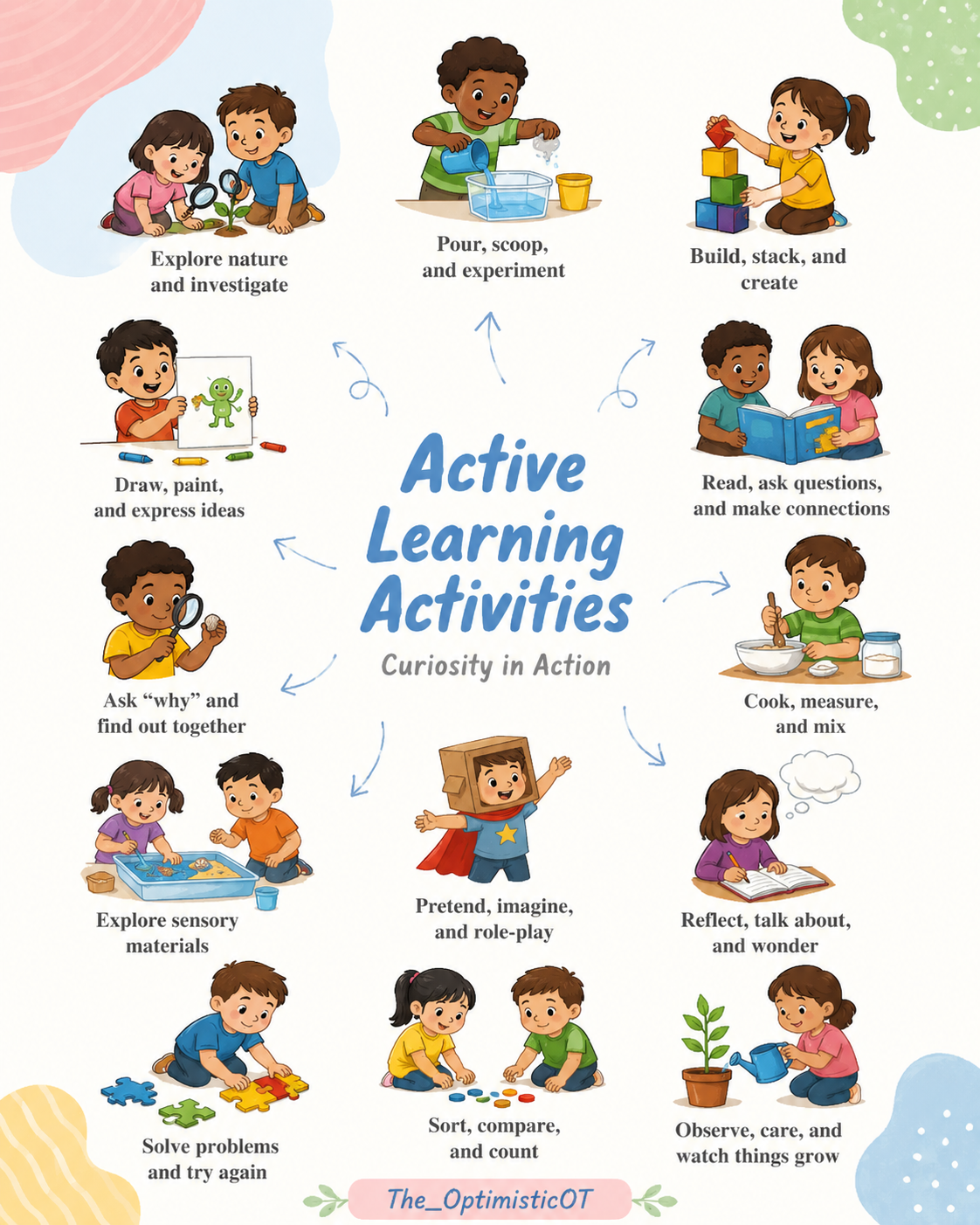
Playful learning research shows that children learn best when experiences are active, engaging, meaningful, socially interactive, and joyful.³ The good news is that parents don’t need to look far; everyday life is already full of learning opportunities.
Water play teaches early science. Sorting socks teaches matching. Blocks teach balance and problem-solving. Pretend play teaches language and creativity. Cooking teaches measurement and cooperation. A walk outside teaches observation, vocabulary, movement, and wonder.
Active learning happens when children participate; using their senses, making decisions, testing ideas, and connecting new experiences to what they know.
What Parents Can Do
When your child asks a question, try saying, “What do you think?”
When something spills, falls, breaks, or changes, try saying, “Let’s figure out what happened.”
When your child struggles, try saying, “You are working hard. What could we try next?”
When your child shows interest in bugs, trucks, clouds, music, cooking, or mud, try joining the curiosity instead of rushing past it.
The goal is not to give children every answer. The goal is to help them become thinkers.
A Gentle Reminder
Active learning can be noisy. It can be messy. It can take longer than doing things yourself. But it is worth it.
Each time a child explores, experiments, asks questions, makes choices, and tries again, they build more than knowledge. They build confidence and learn that mistakes can teach them something.
Active learning does not require a lesson plan. It asks parents to stay curious alongside their child, celebrate questions as much as answers, and trust that children who explore freely are becoming capable learners.
So, the next time your child asks why the moon is following the car, why ants walk in a line, or what happens when they pour water somewhere new – remember: that question is the beginning of something. That is something to celebrate.
References
1. Lillard, A. S., Lerner, M. D., Hopkins, E. J., Dore, R. A., Smith, E. D., & Palmquist, C. M. (2013). The impact of pretend play on children’s development: A review of the evidence. Psychological Bulletin, 139(1), 1–34. https://doi.org/10.1037/a0029321
2. Engel, S. (2011). Children’s need to know: Curiosity in schools. Harvard Educational Review, 81(4), 625–645. https://doi.org/10.17763/haer.81.4.h0541313164731152
3. Zosh, J. M., Hopkins, E. J., Jensen, H., Liu, C., Neale, D., Hirsh-Pasek, K., Solis, S. L., & Whitebread, D. (2017). Learning through play: A review of the evidence. LEGO Foundation. https://cms.learningthroughplay.com/media/wmtllbe5/learning-through-play_web.pdf