How Do You Think She Feels? Helping Your Child Grow Empathy
S – Social Skills to Successfully Navigate Relationships
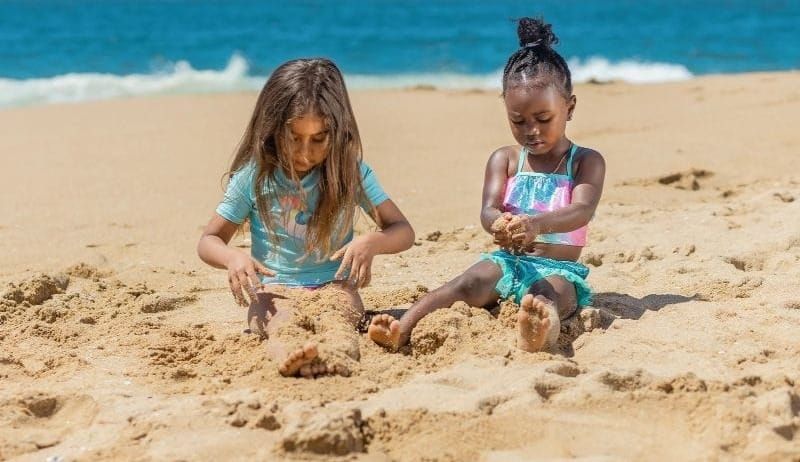
Two children are building a sandcastle when a wave rolls in and washes it away. One laughs at the splash. The other bursts into tears. How can the same wave make one child laugh and the other cry?
Our earlier GREATEST Roadmap posts explored how social skills begin at home and how children learn to share. Empathy begins when children notice how someone else feels, try to understand why, and care about what that person is going through. At the beach, you might say, “The splash made you laugh. Your sister is crying. She worked hard on the castle. Let’s ask if she’d like help building another one.”
How empathy grows
Toddlers. Point out what your child can see or hear. “Your brother is crying. He bumped his knee. Let’s check on him.” Some toddlers may bring a toy. Others may hang back and watch. Show your child one small way to help. “Could you bring me a cloth for his knee? I’ll stay with him.”
In a 2024 study, Markus Paulus and colleagues followed 127 children from 6 to 18 months. They watched how the children reacted to adults who pretended to be hurt or who laughed. In their second year, the children showed increasingly clear signs of concern for the adult who seemed hurt. The researchers concluded that concern for others develops gradually. [2]
Preschoolers. Help your child connect a feeling with what happened. Nia and her brother were getting ready to play outside when it started to rain. Nia frowned. She had been looking forward to drawing on the pavement with her new chalk. Her brother ran to get his boots. He couldn’t wait to splash in the puddles.
Their mother turned to Nia’s brother. “You’re happy because the rain made puddles.” Then she asked Nia, “Are you disappointed because you wanted to use your chalk?” Nia nodded. Her mother asked the children, “What could we do while we wait for the pavement to dry?” Nia’s brother thought for a moment, then asked if she’d like to draw with him indoors.
Early school years. Help your child find out what another person needs. “You like a hug when you’re upset. Your friend might want something different.” Give your child words to ask. “Would you like me to sit with you, or would you like some time alone?” If the friend asks for time alone, encourage your child to give them space and check in later.
The drawing that tore
Three-year-old Malik reaches for a blue crayon and catches the edge of his sister Zoe’s drawing. The paper tears. Zoe cries. Malik holds up the crayon and says, “I just wanted blue.”
Mum kneels beside them. “You wanted the blue crayon. Zoe, are you upset because your picture tore?” Zoe nods and says she wants to keep it. Mum asks Malik to bring the tape and lets Zoe show them where the pieces fit. If Malik is close to tears too, Mum can sit with both children until they’re ready to mend the picture together.
When a friend walks away
Seven-year-old Mara wins a race. Her friend Hani walks off before the next one. “He’s angry because I won,” she says. Her father says, “Let’s ask him what happened.”
Hani tells Mara that two children laughed when he tripped during the race. “I felt silly,” he says. Mara asks if he wants to race again. “I just want to sit for a bit,” he replies. She asks if she can sit with him. He nods and makes room beside him.
Make room for empathy every day
Talk about feelings as they come up. “You got quiet when we left Grandma’s. How were you feeling?” Your child might say, “I was tired,” when you thought they were sad to leave. Let their answer guide what you say next. You can notice happy feelings too. “Your cousin grinned when she saw you at her game. I think she was glad you came.”
Pause during a story. If a character stands apart while others play, point to the picture. “She’s looking at the other children. Do you think she wants to join?” Ask what someone in the story could say to invite her in. With a younger child, you could offer the words yourself. “Come and play with us!”
In a 2025 study by Honglin Chen and colleagues, 60 four- and five-year-olds read picture books with their parents twice a week for eight weeks. One group read stories about friendship, sharing, helping, and working together. The other read books on different topics. On a questionnaire, parents indicated that children who read the stories about getting along with others showed greater gains in empathy. [1]
Try it in pretend play. Set up a pretend picnic. Have one toy stand apart, watching the others eat. Let your child play the host. They might make room and say, “You can sit by me.” Swap roles and ask what would help their toy feel welcome.
Let your child see you offer help. When oranges spill from a neighbour’s bag, ask, “Would you like a hand?” If he says yes, invite your child to help pick them up. Afterwards, point out how your child helped. “You spotted the orange under the bench. That helped Mr Thomas get all his oranges back in the bag.”
Your GREATEST Challenge This Week
Pick one moment in a story or in real life. Ask your child, “How do you think that person feels?” Listen, then ask, “What might help?” If someone needs help right then, try one small kindness together.
Sources
[1] Chen, H., Lyu, D., & Zhu, L. (2025). The effectiveness of social-themed picture book reading in promoting children’s prosocial behavior. Frontiers in Psychology, 16, 1569925. https://doi.org/10.3389/fpsyg.2025.1569925
[2] Paulus, M., Becher, T., Christner, N., Kammermeier, M., Gniewosz, B., & Pletti, C. (2024). When do children begin to care for others? The ontogenetic growth of empathic concern across the first two years of life. Cognitive Development, 70, 101439. https://doi.org/10.1016/j.cogdev.2024.101439