“Just Playing” Is Actually Serious Learning
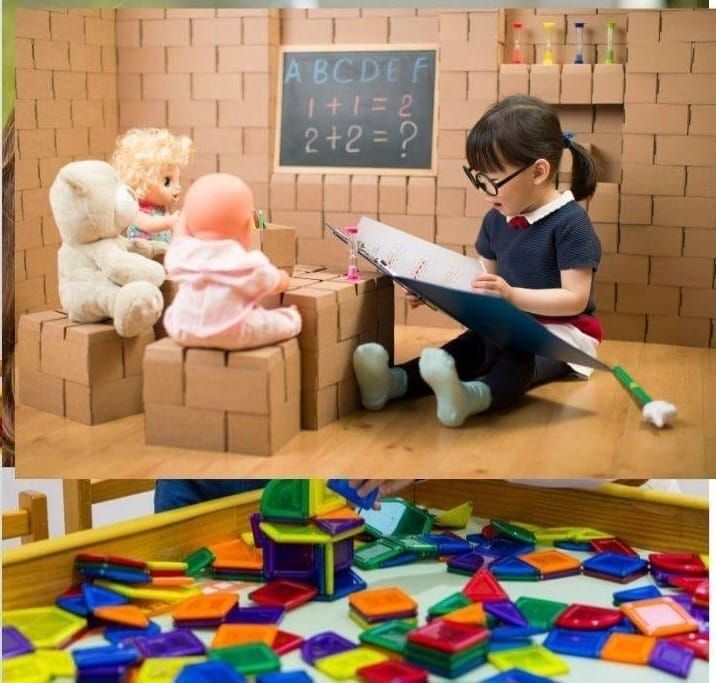
Have you ever looked around your living room and wondered, “How did every cushion, spoon, blanket, and toy end up on the floor?” Your child may proudly announce, “It’s a hospital!” while you wonder, “He should be doing something more educational?”
Here is the good news: your child is probably doing something educational.
In the GREATEST Parenting Roadmap, the first pillar, G – Growth, reminds us that children learn and grow through play. Play supports physical, emotional, social, cognitive, language, and literacy development. When a child stacks blocks, plays pretend school, stirs pretend soup, or gives a teddy bear a check-up, the child is thinking, planning, communicating, imagining, and solving problems.
Still, many parents worry. “Is my child learning enough?” “Should I teach letters and numbers instead?” “Will too much play make my child lazy?” These concerns are understandable in a world that promotes children's academic achievement at an early age. But early childhood learning does not always look like worksheets, flashcards, or sitting still. For young children, learning is active. It happens through touching, moving, pretending, building, talking, and sometimes making a glorious mess.
I once observed a mother who collected her four-year-old daughter from preschool and scolded her for “playing too much instead of learning.” The child’s clothes were smudged, her hair was unruly, and she looked happy. Sadly, the mother saw dirt and wasted time. What she may not have seen was learning behind the dirt: teamwork, language, problem-solving, and emotional growth from negotiating with friends.
That moment stayed with me because it reflected a misunderstanding. Many adults see play as fun, but not always as learning. Yet research continues to show that play builds important skills. Fox, Lang, and Tebben found that early childhood teachers use diverse types of play to support several developmental areas, though adults may still need help using play well. Ndabezitha and Gravett also highlighted guided or intentional play to connect children’s curiosity with intentional learning goals. So, what does this mean at home?
When your child pretends to run a grocery store, learning is happening. They may be counting pretend money, sorting food, taking turns, using new words, and practicing social roles. When a block tower falls, your child is learning about balance, cause and effect, patience, and trying again. When a cardboard box becomes a racing car, your child is using imagination, language, planning, and storytelling.
There are two broad types of play parents can support: free play and intentional play.
Free play is child-led. The child chooses what to do, how to do it, and when to change direction. For example, your child lines up toy animals and sends them to school. You do not need to take over. You can observe, join when invited, and ask, “Who is the teacher today?” or “What happens when the elephant forgets his lunch?” Free play gives children space to develop independence, creativity, and confidence.
Intentional play is still playful, but the adult adds a gentle purpose. This does not mean turning play into a pressured lesson. It means noticing a learning opportunity and extending it naturally. If your child is building, you might say, “I wonder which block would make the tower stronger.” If your child is pretending to cook, you might ask, “Can you give me two carrots and one potato?” Your child is practicing counting, vocabulary, problem-solving, and listening while playing.
The key is balance. Children need time to lead play, and they also benefit from warm guidance. Think of yourself as a partner, not a director. You need not control the story. You can enter the child’s world and stretch their learning.
Here are three examples.
Your child is splashing water in the bath. Instead of saying, “Stop making a mess,” try providing toy items and ask, “What do you think will sink? What will float?” Now your child explores science.
Your child is arguing with a sibling over a toy truck. Instead of immediately taking the truck away, try, “You both want it. What plan can we make?” Now your child is practicing negotiation and regulation.
Your child is drawing circles and lines that do not look like anything to you. Instead of asking, “What is it supposed to be?” try, “Tell me about your picture.” Now your child is building language, meaning, and confidence.
A Practical Activity: The Learning-in-Play Treasure Hunt
For one week, spend ten minutes a day watching your child play. Keep a small notebook nearby. Write down what your child is doing, then identify the learning.
Use these prompts:
1. What is my child trying to do?
2. What words are my child using?
3. Is my child solving a problem?
4. Is my child using imagination?
5. Is my child practicing movement, sharing, waiting, or expressing feelings?
6. How can I gently extend the play without taking over?
This activity helps parents see the learning that is often hidden in plain sight. It also reduces pressure to create perfect learning activities. Your home need not look like a classroom. Your child does not need expensive toys. Pots, boxes, socks, leaves, cushions, spoons, water, songs, stories, and your attention can all become tools for growth.
So next time your living room looks like a zoo or construction site, pause before saying, “Clean up this mess!” Take a closer look. Your child may be building vocabulary, friendship skills, a story, or a stronger sense of self.
That is not “just play.” That is serious learning.
References
Fox, E. G., Lang, S. N., & Tebben, E. (2023). Planning for play in early childhood classrooms. Early Childhood Education Journal.
Ndabezitha, L. B., & Gravett, S. (2024). Guided play as a pedagogical tool for the early grades. South African Journal of Childhood Education, 14(1), Article 1345.