Safe Risks, Stronger Children: Why Children Need Appropriate Challenges
E – Encouraging Independence & Resilience
“Be careful!” “Don’t climb so high!” “Let me do that for you!”
How often do we say these things to our children?
As parents, our instinct is to protect our children from danger, disappointment, and failure. We want them to be safe and happy. But sometimes, in trying to protect them, we unintentionally prevent them from discovering what they can do.
Children need opportunities to try unfamiliar things, face manageable challenges, make mistakes, and experience success.
The goal is not to remove every difficulty from childhood. It is to help children develop the confidence and skills to manage challenges safely.
Why Children Need Challenges
Think about a toddler learning to walk. There are wobbles, falls, and many attempts before those first confident steps.
Now imagine if, every time the toddler stumbled, an adult immediately picked them up and carried them. How would the child develop balance, coordination, and confidence?
The same principle applies to other areas of development.
Climbing, exploring unfamiliar places, learning to ride a bicycle, speaking for themselves, and attempting new skills all provide valuable learning opportunities.
Through appropriate challenges, children learn to:
Judge situations and make decisions.
Develop physical coordination and problem-solving skills.
Manage fear, frustration, and disappointment.
Trust their growing abilities.
Keep trying when something is difficult.
These experiences build independence and resilience.
Safe Risks Are different from Danger.
Allowing children to take risks does not mean exposing them to unnecessary danger.
A manageable risk is a challenge that a child can attempt with suitable adult supervision, support, and precautions.
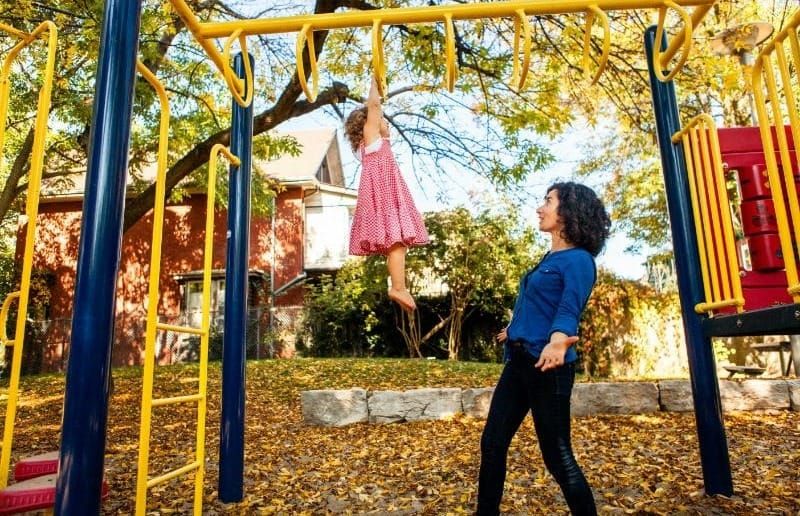
For example, climbing a low playground wooden plank allows a child to practise balance, coordination, and decision-making.
A hazard, however, is something that could cause serious harm, such as broken playground equipment, unsafe heights, or playing near traffic.
Parents must check for hazards, take reasonable safety precautions, supervise appropriately, and consider each child’s age, abilities, and readiness for the activity.
The aim is to provide challenges that stretch children's abilities without placing them in unreasonable danger.
A Little Climber
Four-year-old Daniel wants to climb a playground structure. His mother feels nervous and is about to say, “Come down!”
Instead, she moves closer and asks, “Where will you put your foot next?”
Daniel pauses, looks carefully, and continues climbing.
When he reaches a suitable stopping point, he smiles proudly.
His mother did not remove the challenge. She helped him think through it safely.
“I'm Scared to Try!”: Supporting Cautious Children
Not every child eagerly welcomes new experiences.
Some children are naturally cautious. Others may fear falling, making mistakes, meeting unfamiliar people, or trying something they have never done before.
These feelings deserve understanding, not criticism.
Telling a frightened child, “Don’t be silly!” or “There’s nothing to be afraid of!” may leave them feeling misunderstood.
Instead, acknowledge the feeling and offer manageable steps.
Try saying:
“I can see you are nervous. Would you like to watch first?”
“We can try one little step together.”
“You don't have to do everything today.”
Sometimes, watching another child, practising with a parent, or trying a smaller challenge makes the experience less frightening.
The important thing is to avoid two extremes: forcing children into frightening situations or allowing fear to prevent them from trying anything new.
Confidence grows when children discover that they can face manageable difficulties with support.
One Small Brave Step
Five-year-old Maya refuses to speak during a group activity.
Her father does not pressure her. At home, they practise saying a short sentence together.
Later, Maya agrees to whisper her answer to her teacher. Eventually, she feels ready to speak to the group.
Her progress is gradual, but each step matters.
Being brave does not always mean feeling unafraid. Sometimes, it means trying something small despite feeling nervous.
Confidence Comes From Doing, Not Just Hearing “Good Job”
Parents naturally enjoy praising their children. Encouragement is important, but constant praise alone does not create genuine confidence.
Children develop lasting confidence through the experience of accomplishing something for themselves.
Consider the difference between saying:
“You're amazing! You are the best!”
and
“You kept trying different ways until you solved the problem!”
The second response helps children recognise the effort, thinking, and persistence behind their achievement.
A 2024 study by Xu and colleagues looked at how parents praise children aged 4 to 6. It was found that a balance of praise, with greater emphasis on children’s efforts and actions than on personal qualities, was associated with stronger persistence and greater pleasure in mastering challenges.
The lesson for parents is simple: Notice effort, improvement, and achievement. Let children experience the satisfaction of doing something for themselves.
And remember, not every attempt needs applause. Sometimes a warm smile or “You did it!” is enough.
What Does Research Say About Safe Challenges?
A 2026 Canadian study by Ramsden and colleagues examined the early play experiences and development of nearly 5,000 children entering kindergarten.
Researchers found that children who had more opportunities for adventurous or risky play were less likely to show developmental difficulties at kindergarten age.
The study does not prove that adventurous play directly caused these better outcomes, but it adds to evidence supporting appropriate challenges in early childhood.
Children benefit when adults balance protection with opportunities to encourage children to explore, experiment, and learn.
Everyday Opportunities to Build Courage and Confidence
Parents do not need expensive equipment or special programmes. Everyday experiences provide opportunities.
Toddlers: Encourage climbing suitable low steps with supervision, trying new movements, feeding themselves, and exploring safe environments.
Preschoolers: Provide opportunities to balance, try new playground activities, solve simple problems, and speak for themselves when they feel ready.
Early school-age children: Encourage learning unfamiliar skills, participating in group activities, trying new games, and managing small responsibilities.
Adjust expectations to each child's development and abilities.
When children struggle, ask, “What could you try next?” rather than immediately providing the solution.
Stay nearby when needed but allow them to experience their own progress.
Your GREATEST Challenge This Week
This week, identify one safe challenge your child has been hesitant to attempt.
Invite your child to try it without pressure.
Offer encouragement, provide only the help needed, and allow time to practise.
Afterwards, ask:
“What was difficult?”
“What helped you?”
“What would you like to try next time?”
Celebrate the effort, whether or not the child succeeds immediately.
Final Thoughts: Let Them Discover Their Strength
Children do not become confident because every difficulty is removed from their path.
They grow stronger when loving adults provide appropriate challenges, recognise their fears, protect them from danger, and allow them to discover their abilities.
Remember, we build resilience not by preventing every struggle, but by helping children learn that challenges can be faced, mistakes can be overcome, and progress is possible.
Sometimes the greatest gift we can offer our children is the opportunity to say:
“I was afraid, but I tried and look what I can do!”
References
Ramsden, R., Gill, R., & Brussoni, M. (2026). Associations between early childhood experiences in outdoor play, risky play and screen time, and children's developmental health outcomes in kindergarten in British Columbia. Early Human Development, 222, 106621. https://doi.org/10.1016/j.earlhumdev.2026.106621
Xu, X., Mo, L., Pan, L., & Li, Y. (2024). The ‘praise balance’: Uncovering the optimal recipe for mastery motivation in preschoolers. Journal of Applied Developmental Psychology, 90, 101607. https://doi.org/10.1016/j.appdev.2023.101607