Social Skills Begin at Home: Raising Children Who Connect with Others
S – Social Skills to Successfully Navigate Relationships
Where does a child’s first lesson in friendship begin? Often, long before there is a friend: in a parent’s smile, a grandparent’s patient response, or a sibling’s invitation to play.
Under the second E in our GREATEST Roadmap, we explored independence, responsibility, perseverance, confidence, and resilience. Now we turn to S: helping children use their growing abilities to connect with others. Alongside “I can do it,” children begin learning to ask, “Can we do it together?”
The family is a child’s first classroom for learning how to relate to others.
More Than Good Manners
Social development means learning how to communicate, understand feelings, cooperate, and build relationships. These skills help children join play, ask for help, manage disagreements, and feel that they belong.
“Please” and “thank you” matter. Children also need help listening, noticing another person’s needs, and disagreeing respectfully. A child who says polite words may still need support to wait for a turn or comfort someone who is upset.
These lessons take time. Young children need patient guidance and many opportunities to practise. A tired toddler may struggle to wait, even after managing well yesterday. Offer support and try again later. Progress often comes in small steps, such as asking for a toy instead of grabbing it, or waiting while someone finishes speaking.
Connection Comes First
Before children speak, they communicate through cries, movements, sounds, and expressions. When you respond, your baby experiences a simple exchange: “I send a message, and someone responds.”
Learn to decipher your baby’s sounds, notice what they point towards, and talk about it. During dressing, describe what you are doing and pause for their response. These small moments introduce listening and taking turns.
Warm relationships give children a safe place to learn. They can make mistakes, feel frustrated, or disagree while knowing that they are loved.
A Struggle Over a Toy
Four-year-old Mara grabs a teddy bear from her five-year-old brother, Joshua. He shouts and pulls it back.
Their father kneels beside them. “You both want the teddy. I will not let you hurt each other.” He helps Mara return it, then listens to each child.
“What could we do?” he asks. Joshua suggests that Mara can have the teddy after his pretend picnic. Their father helps Mara ask, “Can I have it when you finish?” While she waits, he offers another toy.
Later, he notices their progress and compliments them: “Good, you used words and found a way to take turns.”
Research offers a useful example. In a 2014 study involving children aged three and a half to eleven, Ross and Lazinski taught parents to guide sibling disagreements. Compared with children whose parents intervened and provided the solutions, these children were more likely to suggest solutions and discuss each other’s feelings.[1]
The everyday lesson is simple: once everyone is calm, help children listen and work towards a solution. Younger children will need more help. Children without siblings can practise with parents, cousins, caregivers, or friends.
Everyday Moments That Teach Social Skills
You do not need expensive toys or special lessons. Ordinary family activities offer plenty of practice.
Listen during conversation. Give your child time to finish, whether they use speech, gestures, signs, or a communication device. Put aside distractions when possible and show that their message matters.
Work together. Say, “You hold the bag while I put the fruit inside.” Let your toddler pass you clothes for folding, or your preschooler help set the table. Shared tasks give children practice cooperating.
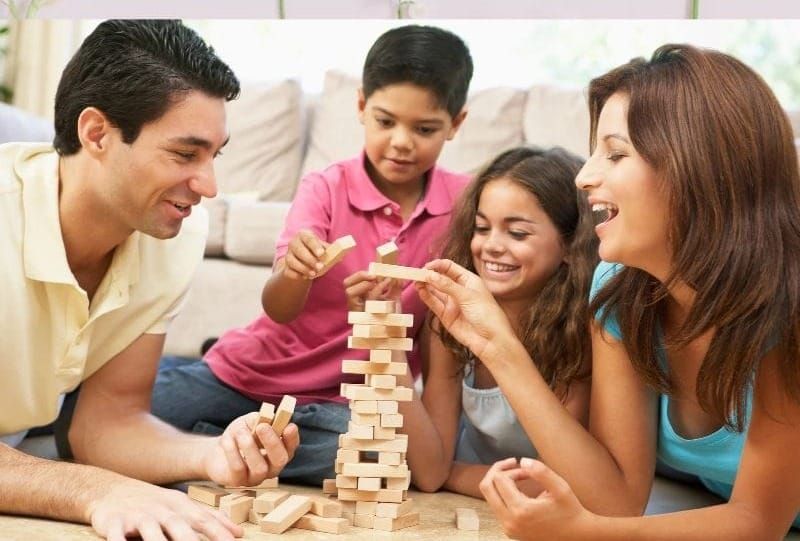
Take turns through play. Roll a ball back and forth, add puzzle pieces together, play board games, or let each person choose a song during a family song activity.
Show how to put things right. “I interrupted you. I am sorry. Please finish.” Children learn from seeing adults take responsibility, repair connections, and change their behaviour.
Talk About Feelings
Help children find words for their feelings: “You’re disappointed because the game ended.” Add a clear limit when needed: “It is okay to feel angry. I will not let you hit.”
Stories also invite conversation. Ask, “How do you think she feels?” or “What could her friend do?” Listen to your child’s ideas rather than rushing to supply an answer.
Brownell and colleagues’ 2013 research found that toddlers whose parents invited them to talk about feelings in picture books tended to share and help someone in need more readily. This was a link, rather than proof that these conversations caused the behaviour.[2]
Try one simple question during storytime. With a younger child, point to a face and ask, “Happy or sad?”
A Quiet Greeting
Four-year-old Daniel hides behind his grandmother when a familiar neighbour greets him.
Instead of calling him rude, she says, “You can say hello or give a little wave.” She greets the neighbour warmly and gives Daniel time.
Later, they practise greetings with his toy bear. The next day, Daniel gives the neighbour a small wave.
Social confidence does not require an outgoing personality. Quiet children can connect in their own way. Offer gentle opportunities without forcing hugs, eye contact, or conversation. Respecting children’s boundaries helps them learn to respect others’ boundaries too.
Children develop at different rates. Adjust your support to your child’s abilities and communication needs.
Your GREATEST Challenge This Week
Choose one daily moment, playtime, a meal, or tidying up to practise listening or taking turns, working together for five minutes.
At the end of the week, reflect: What helped us connect and cooperate?
As we begin the S pillar, remember that social learning grows through everyday experiences of being heard, guided, and included. Home does not need to be perfect to offer these lessons.
References
1. Ross, H. S., & Lazinski, M. J. (2014). Parent mediation empowers sibling conflict resolution. Early Education and Development, 25(2), 259–275. https://doi.org/10.1080/10409289.2013.788425
2. Brownell, C. A., Svetlova, M., Anderson, R., Nichols, S. R., & Drummond, J. (2013). Socialization of early prosocial behavior: Parents’ talk about emotions is associated with sharing and helping in toddlers. Infancy, 18(1), 91–119. https://doi.org/10.1111/j.1532-7078.2012.00125.x